
Chapter 3: AI Reshapes Work and Human Roles
AI Reshapes Work and Human Roles 🤝
Section titled “AI Reshapes Work and Human Roles 🤝”Learning how to team up with AI while keeping humans in the driver’s seat.
Whenever people talk about the future of Artificial Intelligence, the conversation almost always turns to a single, slightly scary question: Are the robots going to take all our jobs?
If you watch a lot of science fiction movies, you might picture a world where humanoid robots are doing everything from teaching math classes to cooking in restaurants. But the real-world impact of AI is actually much more subtle — and a lot more interesting. AI is not showing up to work in a robot suit to replace you. Instead, it is living inside your laptop, your smartphone, and the software you use every day, offering to be your ultimate, super-fast assistant.
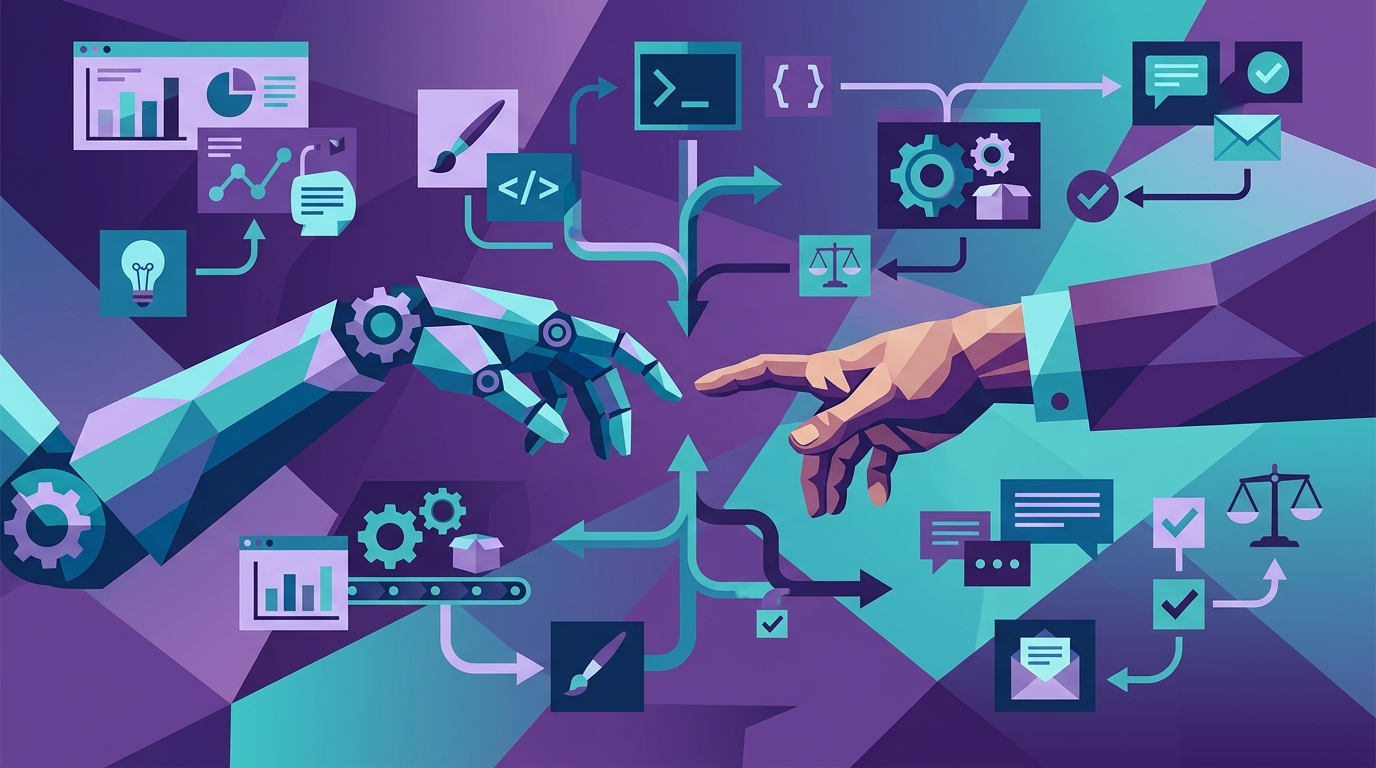
The future of work, and the future of school, is not about humans versus machines. It is about humans collaborating with machines. AI systems are rapidly transforming industries, changing how doctors diagnose illnesses, how musicians mix audio, and how software engineers write code. But these tools cannot do it alone. To thrive in an AI-powered world, you need to learn how to be a good manager. You have to learn how to divide up a project, give crystal-clear instructions to a machine, and ultimately, take responsibility for the final result. You are the pilot; AI is just the autopilot.
3.1 — Automating the Boring Stuff ⚙️
Section titled “3.1 — Automating the Boring Stuff ⚙️”To understand how AI is reshaping work, we first have to understand what it is exceptionally good at: automationautomation: Using technology to perform a task with very little or no human effort. AI automates tasks by following rules, recognizing patterns, and processing data far faster than a human could.. Automation simply means using technology to perform a task with very little human effort.
AI systems are brilliant at automating structured tasksstructured tasks: Tasks that follow clear, well-defined rules and patterns. Examples include grading multiple-choice tests, sorting emails, or scanning documents for keywords. These are tasks where the 'right answer' is clearly defined.. A structured task is anything that follows a clear set of rules, requires finding patterns in massive amounts of data, or involves organizing information. Think about a teacher trying to grade 100 multiple-choice tests. The rules are clear: if the student bubbled “C,” it is correct; anything else is wrong. A computer can grade those 100 tests in a fraction of a second. That is automation.
Real-World Automation in Action
Section titled “Real-World Automation in Action”In the real world, AI is automating all kinds of structured tasks:
| Task | How AI Automates It |
|---|---|
| Email management | Sorting through thousands of emails to filter out spam |
| Legal research | Helping lawyers scan hundreds of pages to find specific keywords |
| Medical imaging | Helping doctors review thousands of X-rays to highlight tiny anomalies |
| Homework organization | Turning five pages of messy handwritten notes into neat bulleted lists or digital flashcards |
When AI takes over these repetitive, time-consuming chores, it frees up human time and energy. But what should humans do with that extra time?
3.2 — Decomposing the Problem: The Human Edge 🧩
Section titled “3.2 — Decomposing the Problem: The Human Edge 🧩”If AI is handling the heavy lifting of sorting and organizing, human beings are needed for the things machines simply cannot do: demonstrating empathy, exercising creativity, understanding deep context, and making ethical judgments.
When you are faced with a big, complex project, the most important skill you can develop is decompositiondecomposition: In computer science, the process of breaking a massive, complex problem down into smaller, more manageable pieces. This lets you decide which tasks are best handled by a human and which can be delegated to AI.. In computer science, decomposition means breaking a massive problem down into smaller, manageable pieces. Once you break a project into pieces, you can decide which pieces belong to the AI and which pieces belong to you.
Example: The Documentary Project 🎬
Section titled “Example: The Documentary Project 🎬”Imagine your teacher assigns a massive group project: you have to create a five-minute documentary video about the history of your town. How do you divide the work between your human group members and your AI assistant?
Task 1: Gathering basic facts. (AI’s job) 🤖 Using a school-approved AI tool (or, if you are under 13, with your teacher running it), you can quickly summarize long articles about your town’s founding and build a timeline of major events.
Task 2: Interviewing a local historian. (Human’s job) 👤 An AI cannot look an elderly historian in the eye, show empathy, and ask follow-up questions based on the emotion in their voice. That requires a human connection.
Task 3: Transcribing the interview. (AI’s job) 🤖 You can feed the audio recording of the interview into an AI tool, and it will automatically type out every single word that was said in seconds.
Task 4: Directing and editing the emotional arc. (Human’s job) 👤 The AI does not know what makes your classmates laugh or cry. You have to be the one to choose the perfect music, edit the clips together to tell a compelling story, and decide the creative vision.
By decomposing the problem, you use AI to augmentaugment: To enhance or add to human abilities. When AI augments your work, it handles the repetitive or data-heavy tasks so you can focus your energy on creativity, connection, and critical thinking. (or enhance) your own human capacity. You let the machine handle the structured data, leaving you completely free to focus on creativity, connection, and storytelling.
3.3 — The Art of Being the Boss: Prompt Engineering 💬
Section titled “3.3 — The Art of Being the Boss: Prompt Engineering 💬”Even if you know exactly what you want the AI to do, you still have to know how to ask for it. Remember from Chapter 1 that AI does not actually understand what you want; it only calculates the most mathematically probable response to your input. Because AI is incredibly literal, giving it vague instructions will result in vague, unhelpful answers.
Learning how to give clear, structured instructions to a generative AI system is a skill called prompt engineeringprompt engineering: The practice of crafting specific, well-structured text instructions (prompts) to guide an AI system toward producing the most useful and relevant output. A good prompt includes a role, context, and clear rules.. A prompt is simply the text you type into the chatbox to tell the AI what to do. If you want the AI to be a helpful assistant, you have to be a good boss and provide specific directions, context, and evaluation criteria.
Weak vs. Strong Prompts
Section titled “Weak vs. Strong Prompts”Let’s say you are studying for a science test on ecosystems.
Look at the difference! The strong prompt gave the AI:
- A specific role (“act as a friendly science tutor”)
- A specific context (“7th-grade ecosystems”)
- Specific rules to follow (“wait for me to answer”)
By taking control and engineering your prompt, you managed the AI, forcing it to adapt to your specific learning needs rather than just accepting whatever random facts it decided to spit out.
3.4 — The Ultimate Responsibility 🎯
Section titled “3.4 — The Ultimate Responsibility 🎯”As you learn to manage AI, you will discover that it is incredibly powerful, but it is also reckless. AI systems will confidently invent facts (hallucinate), generate biased content, or accidentally copy someone else’s copyrighted work. Because of this, you can never completely hand over the steering wheel.
Whenever you collaborate with AI, the final ethical responsibility always falls on the human:
- If you use an AI tool to help you write a line of code for a video game, and that code breaks the game, you cannot blame the AI. You chose to put that code in your game.
- If you use an AI to help you draft an email to your teacher, and the AI uses an inappropriate, sarcastic tone that you don’t catch before hitting send, you are the one who gets in trouble.
Being an AI-literate manager means you must always establish a system of human reviewhuman review: The practice of carefully checking, verifying, and editing any output generated by an AI before using it. Human review ensures accuracy, appropriate tone, and ethical standards are maintained.. You have to read every word the AI generates. You have to fact-check its historical dates. You have to ask yourself, “Does this sound like my authentic voice?” and “Is it fair to submit this as my own work?”
Part of this responsibility is being transparenttransparent: Being open and honest about how AI was used in your work. Transparency means clearly communicating which parts were AI-assisted and which parts are your own original thinking.. Whether you are in school or in a future career, you should always communicate clearly about how you used AI. Adopting a guideline like, “I used AI to help brainstorm ideas and check my spelling, but I wrote the final paragraphs myself,” shows that you are an honest, ethical creator.
3.5 — New Jobs the AI Era Is Creating 🆕
Section titled “3.5 — New Jobs the AI Era Is Creating 🆕”Here is some great news that often gets buried under all the scary headlines: AI is not just eliminating jobs. It is also creating entirely new ones that barely existed ten years ago. If you were in middle school in 2015, you might have told a career counselor, “I want to be a Prompt Engineer,” and they would have had absolutely no idea what you were talking about. Today, it is one of the most sought-after tech skills in the industry.
Here are five exciting career paths that have exploded in the AI era:
🤖 AI/ML Engineer
Section titled “🤖 AI/ML Engineer”What they do: These engineers actually build the AI models — they design the neural network architecture, write the code that trains the model on data, and optimize the system for speed and accuracy. They are the people who built the tools you use every day. Education path: Typically a Bachelor’s or Master’s degree in Computer Science or a related field, with deep knowledge of math, statistics, and programming (especially Python).
📊 Data Scientist
Section titled “📊 Data Scientist”What they do: Data scientists sit between raw data and meaningful insight. They collect massive datasets, clean and organize them, run statistical analyses, build predictive models, and translate the results into business decisions. Think of them as translators between the language of data and the language of human decisions. Education path: Usually a degree in Statistics, Mathematics, Computer Science, or Data Science, plus hands-on experience with data analysis tools.
✍️ Prompt Engineer
Section titled “✍️ Prompt Engineer”What they do: These specialists craft the precise instructions and context that unlock the best performance from AI systems. They run experiments, test different wording strategies, and figure out how to get an AI to produce expert-level outputs for specific industries like law, medicine, or education. Education path: Currently less rigid — many prompt engineers come from writing, linguistics, or subject-matter expert backgrounds, combined with hands-on AI tool experience.
⚖️ AI Ethics Officer
Section titled “⚖️ AI Ethics Officer”What they do: These professionals ensure that AI systems built by a company are fair, transparent, and safe. They review models for bias, create ethical guidelines for development teams, liaise with regulators, and advocate for the people who might be harmed by a flawed AI system. Education path: Often a background in philosophy, law, social science, or public policy — combined with enough technical literacy to understand how AI systems work.
🏷️ AI Trainer / Data Annotator
Section titled “🏷️ AI Trainer / Data Annotator”What they do: As we learned in Chapter 2, AI needs labeled data to learn. AI trainers and annotators do this work: they label images, rate AI responses, create test scenarios to find model weaknesses, and provide the human feedback that shapes how AI systems improve. They are often the first humans an AI ever “listens” to. Education path: Entry-level positions exist with no college degree required. Many annotators work freelance. Specialized roles (like medical image annotation) require domain expertise.
Career Overview Table
Section titled “Career Overview Table”| Job Title | What They Do | Avg. Salary Range (US) | Education Needed |
|---|---|---|---|
| AI/ML Engineer | Builds and trains AI models | $120,000–$200,000+ | BS/MS in Computer Science |
| Data Scientist | Analyzes data to find patterns and build predictions | $100,000–$160,000 | BS in Math/Stats/CS |
| Prompt Engineer | Crafts optimal instructions for AI systems | $70,000–$150,000 | Varies — often domain expertise + AI experience |
| AI Ethics Officer | Ensures AI is fair, safe, and compliant | $90,000–$160,000 | Background in law, philosophy, or social science |
| AI Trainer / Annotator | Labels data and evaluates AI outputs | $15–$30/hr (entry-level) to $80,000+ (specialized) | Entry-level to domain expertise |
3.6 — Jobs Being Transformed, Not Erased 🔄
Section titled “3.6 — Jobs Being Transformed, Not Erased 🔄”The most accurate way to describe AI’s impact on most professions is not “replacement” — it is augmentationaugmentation: The use of AI to enhance and expand human capabilities, rather than replace them. Augmented workers use AI to handle repetitive tasks, giving them more time and energy for the creative, complex, and human-centered parts of their work.. AI handles the repetitive, data-heavy tasks; humans handle the nuanced, high-judgment, empathetic ones. Here is what that looks like in four real professions:
🩺 Radiologists (Doctors Who Read Medical Scans)
Section titled “🩺 Radiologists (Doctors Who Read Medical Scans)”- Before AI: A radiologist might spend 10 hours per day studying hundreds of X-rays, CT scans, and MRIs, looking for tiny anomalies that could indicate cancer, a broken bone, or a blood clot. Human eyes get tired.
- With AI: An AI system scans the images first and highlights every area that looks statistically unusual — flagging potential tumors, fractures, or anomalies in seconds. The radiologist then reviews only the flagged areas, applies medical judgment, considers the patient’s history, and makes the final diagnosis.
- The Human Edge: The AI cannot talk to the patient. It cannot weigh the emotional impact of a cancer diagnosis. It cannot decide whether to recommend a risky surgery based on a patient’s personal values and quality of life. The doctor does all of that.
⚖️ Legal Researchers (Lawyers’ Assistants)
Section titled “⚖️ Legal Researchers (Lawyers’ Assistants)”- Before AI: Building a legal case often meant reading tens of thousands of pages of contracts, court transcripts, and precedent cases to find the one relevant paragraph buried somewhere in the pile.
- With AI: AI “e-discovery” tools can scan and summarize 10,000-page document collections in minutes, flagging every mention of specific dates, names, or legal terms.
- The Human Edge: A lawyer then applies legal reasoning to construct an argument, reads the emotional dynamics of the courtroom, and advocates passionately for their client’s rights. AI cannot do any of that.
🎵 Music Producers
Section titled “🎵 Music Producers”- Before AI: Creating a beat required manually programming every drum hit, bass line, and chord sequence, or playing them live.
- With AI: AI music tools can generate an entire instrumental track — complete with melody, harmony, and rhythm — in seconds based on a genre description. Artists can have 50 rough beats to choose from in an hour.
- The Human Edge: The artist decides which emotions the music should evoke, how the beat should flow with their lyrics, and what the final artistic vision is. They select, shape, and transform the raw AI material into something with cultural meaning and personal expression.
🎧 Customer Service Representatives
Section titled “🎧 Customer Service Representatives”- Before AI: Every customer inquiry — from “Where is my package?” to “I was charged the wrong amount” — required a human agent to research and respond.
- With AI: Chatbots and virtual assistants now handle the 80% of inquiries that are simple, repetitive, and follow predictable patterns (“Track order,” “Reset password,” “Check balance”).
- The Human Edge: When a customer is upset, dealing with a loss, or has a complex problem that doesn’t fit any standard script, they get escalated to a human agent who can listen with empathy, improvise, and make judgment calls that a script cannot anticipate.
3.7 — Skills That Will Always Matter 💪
Section titled “3.7 — Skills That Will Always Matter 💪”If AI can write essays, generate code, analyze data, and translate languages, what is left for humans to do? The answer is: the things that make us human. Here are five skills that AI genuinely cannot replicate — and why building them now matters more than ever:
🧠 Critical Thinking
Section titled “🧠 Critical Thinking”Why AI can’t do it: AI generates plausible answers, not necessarily correct ones. It cannot evaluate the quality of its own output, recognize when its training data was flawed, or catch its own hallucinations. Classroom example: When you use an AI to help research a history project, you have to fact-check the AI’s claims against a reliable source. The ability to evaluate whether information is trustworthy, logical, and well-sourced — that is critical thinking, and it is entirely yours.
🎨 Creativity
Section titled “🎨 Creativity”Why AI can’t do it: AI remixes existing patterns; it cannot generate a truly original concept that has never existed before. It cannot feel the spark of an idea born from lived experience, boredom, heartbreak, or joy. Classroom example: You might use AI to generate ten variations of a poem’s opening line. But you are the one who decides which line resonates, why it matters, and what you actually want to say. The creative vision — the “why” — is human.
💙 Empathy
Section titled “💙 Empathy”Why AI can’t do it: AI does not feel. It can simulate empathetic language because it learned what empathetic words look like — but it has no genuine understanding of another person’s emotional experience. Classroom example: When a classmate is struggling and you notice something is wrong — even when they say “I’m fine” — you are reading subtle social cues that no AI can currently pick up. Knowing when to sit with someone in silence, or when to tell a joke to lighten the mood, requires genuine human emotional intelligence.
⚖️ Ethical Judgment
Section titled “⚖️ Ethical Judgment”Why AI can’t do it: AI can describe ethical frameworks, but it cannot feel moral weight. It cannot truly grapple with the reality that a decision will hurt real people with real lives. Classroom example: Your class might debate whether your school should use an AI to monitor students’ online activity for bullying. The AI cannot decide what is right — it can only do what it is told. Humans have to weigh freedom, safety, privacy, and trust. That is an ethical judgment.
🗣️ Communication
Section titled “🗣️ Communication”Why AI can’t do it: Authentic human connection — the ability to inspire, persuade, console, or lead real people in real moments — requires presence, personality, and lived credibility. Classroom example: You can use AI to draft a speech for your student council campaign. But the moment you stand at the front of the room, make eye contact with your classmates, and speak from your own experience and values — that is something no AI can do for you.
Career Scenarios: What Changes, What Stays Human
Section titled “Career Scenarios: What Changes, What Stays Human”| Career | What AI Will Handle | What Remains Human |
|---|---|---|
| 🩺 Doctor | Analyzing test results, flagging anomalies in scans, suggesting diagnoses | Building patient trust, making treatment decisions, delivering difficult news with compassion |
| 📚 Teacher | Grading multiple-choice tests, generating practice problems, adapting content difficulty | Inspiring students, noticing who is struggling emotionally, building classroom culture |
| 📰 Journalist | Searching for data patterns, summarizing public records, writing routine reports | Investigating sources, asking hard questions in person, making ethical decisions about what to publish |
| 💻 Software Engineer | Generating boilerplate code, finding bugs, suggesting code optimizations | Designing the overall system architecture, understanding user needs, making tradeoffs |
| 👨🍳 Chef | Generating recipe variations, predicting ingredient trends, optimizing supply chains | Creating dishes with cultural meaning, improvising based on what’s available, cooking with love and intention |
Chapter Activity: The History Team-Up 📚
Section titled “Chapter Activity: The History Team-Up 📚”Let’s practice delegating tasks and managing an AI system for a school project. Imagine you have been asked to write a report on the history of the Apollo 11 moon landing. You have three primary sources:
- 📄 A highly technical 50-page NASA engineering manual
- 📓 A personal diary entry from astronaut Michael Collins
- 📰 A newspaper opinion piece from 1969 arguing that the space program costs too much money
Step 1: Decompose the Task
Section titled “Step 1: Decompose the Task”Which of these three documents would you assign an AI to read and summarize for you, and why? Which document would you insist on reading yourself to understand the human emotion and historical context?
Step 2: Draft the Prompt
Section titled “Step 2: Draft the Prompt”Write a strong, 3-sentence prompt instructing an AI on exactly how you want it to summarize the document you assigned it. Be sure to give it:
- 🎭 A role (e.g., “Act as a research assistant…”)
- 📏 A word limit (e.g., “Summarize in 200 words or fewer…”)
- 🎯 A specific goal (e.g., “Focus on the key engineering challenges…”)
Step 3: The Human Check
Section titled “Step 3: The Human Check”If the AI summarizes the newspaper opinion piece, why is it dangerous to accept that summary as an absolute, objective fact? What is your responsibility as the human historian when reading the AI’s output?
Step 4: Career Connection 🚀
Section titled “Step 4: Career Connection 🚀”Look back at the Career Scenarios table in Section 3.7. Choose one career that interests you. Write a paragraph answering: “In this career, how would I personally use AI as a tool while making sure the most important parts of the job stay human?”
Key Concepts Checklist
Section titled “Key Concepts Checklist”- I understand what automation is and what kinds of tasks AI can automate
- I can decompose a complex project into AI tasks and human tasks
- I know what prompt engineering is and can write a strong vs. weak prompt
- I understand that the human always bears final responsibility for AI output
- I can explain why human review is essential when using AI tools
- I know the importance of transparency when using AI in my work
- I can name at least three new AI-era careers and describe what those workers do
- I understand what augmentation means and can give an example of a job being augmented by AI
- I can explain why AI cannot fully replace roles requiring empathy, ethical judgment, or creative vision
- I can identify the uniquely human skills that will remain essential in an AI-powered world