
Chapter 5: The AI Problem Solver
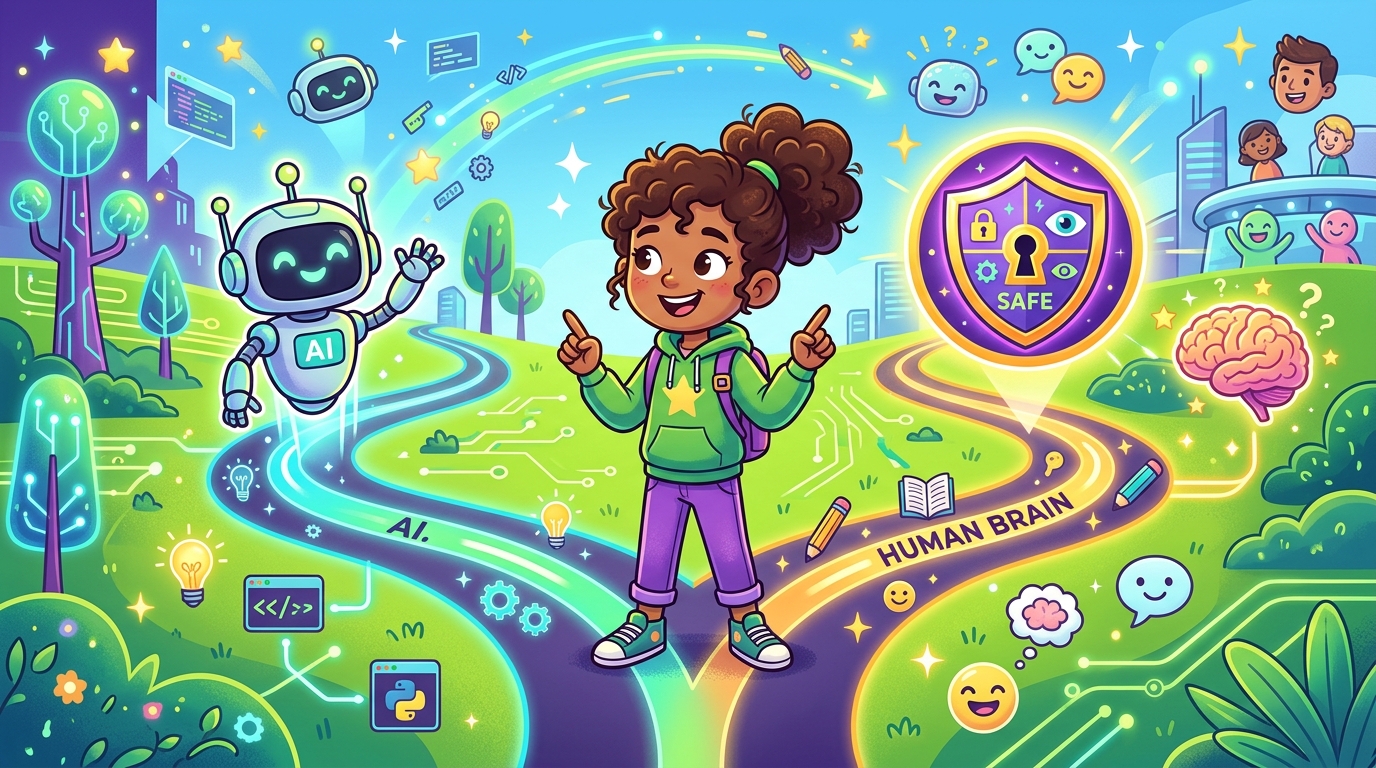
The AI Problem Solver 🦸
Section titled “The AI Problem Solver 🦸”Welcome back, AI Explorers! We have made it to our final chapter together. Throughout our incredible journey, you have learned what AI is, how to speak its language by thinking like a computer, how to spot its mistakes with your detective skills, and how to use it as the ultimate Brainstorming Buddy.
You now have some serious AI superpowers in your utility belt! But as every good superhero knows, having superpowers means you have to use them responsibly. A superhero wouldn’t use their super-strength to open a fragile jar of jelly, and they wouldn’t use their laser vision just to toast a marshmallow! They have to make smart choices.
Just because AI can do something doesn’t mean it should. In this final chapter, we are going to learn how to make smart, ethical, and safe choices about when to use AI, when to protect your privacy, and when it is better to rely entirely on your amazing human brain.
5.1 — The Right Tool for the Job 🛠️
Section titled “5.1 — The Right Tool for the Job 🛠️”Imagine you are trying to cut out a delicate, beautiful paper snowflake. Would you use a heavy metal hammer to do it? Of course not! A hammer is a fantastic tool for building a treehouse, but it is the completely wrong tool for cutting paper. You need scissors.
AI is just like that hammer. It is a very powerful tool, but it is not the right tool for every single job in your life. Knowing when to use AI is just as important as knowing how to use it.
🟢 When AI is a Great Tool
Section titled “🟢 When AI is a Great Tool”| Situation | Why AI Helps |
|---|---|
| Sparking Ideas | Staring at “The Blank Page”? AI is great at generating a big list of ideas for a story, drawing, or science fair project so you can pick your favorite. |
| Learning New Things | AI can explain a confusing topic — like how a black hole works or how a submarine dives — using words a 4th grader can easily understand. |
| Checking Your Work | After you have already written your essay yourself, AI can act like a second pair of eyes to catch small spelling or grammar mistakes. |
| Practicing a Skill | Learning a new language like Spanish or French? With your teacher, watch an AI on the class screen practice a simple conversation, and you suggest what to say next — a fun way to practice without feeling embarrassed! |
🔴 When AI is the Wrong Tool
Section titled “🔴 When AI is the Wrong Tool”| Situation | Why You Should Think Twice |
|---|---|
| Doing Your Homework For You | If AI solves your math problems or writes your history report, you are cheating yourself out of learning. Think of your brain like a muscle — if a robot lifts weights for you, your muscles won’t get stronger! |
| Expressing Real Feelings | If you accidentally hurt your friend’s feelings or want to write a Mother’s Day card, use your own words. Your friends and family want to hear from you, not a computer. AI doesn’t have a heart, so it can’t say “I’m sorry” or “I love you” and truly mean it. |
| Sharing Private Information | Never tell an AI your full name, home address, passwords, or where you go to school. AI programs save the information you type into them. Keep your personal secrets locked safely in your own human brain! |
5.2 — Fairness and Feelings ⚖️
Section titled “5.2 — Fairness and Feelings ⚖️”Do you remember way back in Chapter 1 when we learned that AI only knows what humans teach it? That means if humans make a mistake — or if humans forget to include something important — the AI will make a mistake, too.
Let’s imagine you are training an AI to recognize pictures of apples. But you only show it pictures of red apples. Thousands of red apples — but never a green apple or a yellow apple. If you hold up a Granny Smith green apple to the camera, the AI might beep and say, “That is not an apple!”
The AI isn’t trying to be mean to green apples, but its information is incomplete. It has a giant blind spot. This is called BiasBias: When AI is unfair, favors one group over another, or leaves certain things out entirely because it didn't learn the whole story. Bias comes from incomplete or unbalanced information. (BYE-us). Bias happens when AI is unfair, favors one group over another, or leaves certain things out entirely because it didn’t learn the whole story.
Because human beings aren’t perfect, the information we feed into AI isn’t perfect either. Here are a few ways bias can show up:
- 🏀 If you ask an AI to draw a picture of a “basketball player” and it only ever draws tall men — never women or kids playing wheelchair basketball — that is bias.
- 🎙️ If a voice assistant can easily understand your voice but struggles with someone who has a different accent, that is bias in its programming.
- 📖 If an AI generates a story that only features boys as brave knights and girls as helpless princesses — simply because it was trained on too many older books with that pattern — that is bias.
As an AI Explorer, you have to watch out for bias! If an AI says something that feels unfair, leaves people out, or relies on stereotypes, it is your job to use your Human Advantage and say:
“Wait a minute — that’s not right!”
You can even use your voice to tell adults or the companies that make the AI that their program needs to be fairer.
5.3 — You Are the Captain ⚓
Section titled “5.3 — You Are the Captain ⚓”Technology can sometimes feel so big, so fast, and so powerful that it is easy to think it is the boss. But always remember this: You are the captain of the ship.
A motor can make a boat go incredibly fast, but without a captain to steer the wheel, the boat will just spin in circles or crash into the rocks! The AI is just the motor helping you get where you want to go. You are the one steering.
- ✏️ You get to decide what prompts to write
- 🔍 You get to decide if the AI’s answer is a fact or a hallucination
- ⚖️ You get to decide if the AI’s ideas are fair, kind, and unbiased
- 🌳 And most importantly, you get to decide when to turn the screen off and go play outside!
No computer program can replace the feeling of warm sunshine on your face, the smell of rain, or the sound of laughing with your best friends. AI is amazing, but the real world is even better.
By thinking like a computer, checking facts like a detective, protecting your privacy, and creating like an artist, you are ready to team up with technology to make the world a brighter, cooler, and more fun place.
Chapter 5 Activity: The AI Traffic Light 🚦
Section titled “Chapter 5 Activity: The AI Traffic Light 🚦”Your Mission: It is time to practice making smart choices! You are going to use the “AI Traffic Light” to decide if using AI in different situations is a good idea or a bad idea.
Step 1: Get Your Colors Ready
Section titled “Step 1: Get Your Colors Ready”Grab a red, yellow, and green marker, crayon, or colored pencil. If you don’t have colors, you can just write the words “Green,” “Yellow,” or “Red” next to each number.
Step 2: Read the Scenarios
Section titled “Step 2: Read the Scenarios”Read the situations below very carefully. Think about everything you have learned in this book. Decide which color traffic light each situation deserves:
| Color | What It Means |
|---|---|
| 🟢 Green Light | Go ahead! This is a great, helpful, and safe way to use AI. |
| 🟡 Yellow Light | Slow down! Use caution — you can use AI here, but you need to be careful, double-check the facts, and do a lot of the work yourself. |
| 🔴 Red Light | Stop! This is not a good or safe way to use AI. |
The Scenarios
Section titled “The Scenarios”- You are stuck on a tough math problem and ask the AI to just give you the final answer so you can hurry up and go play outside.
- You ask an AI to give you a list of 5 possible topics for your science fair project to help you brainstorm.
- You use AI to write a poem for your mom for Mother’s Day and sign your name at the bottom so she thinks you wrote it.
- You ask an AI to explain how a volcano erupts because you didn’t understand the big words in your science book.
- An AI chatbot asks you to type in the name of your school and your home address so it can write a personalized story about your neighborhood.
- You write a paragraph about the Solar System, and you ask the AI to check if you spelled the word “Jupiter” correctly.
- You ask an AI to write your entire book report for you because you forgot to finish reading the book over the weekend.
Step 3: Discuss and Defend
Section titled “Step 3: Discuss and Defend”Compare your traffic lights with a partner or a teacher. Do your colors match? Take turns explaining why you chose Green, Yellow, or Red for each scenario. If you disagree on a color, use your debate skills to try and convince your partner why your traffic light is the safest choice!
🎉 Congratulations! You have completed the book and are officially a Master AI Explorer! 🌟