
Chapter 3: The AI Detective
The AI Detective 🔍
Section titled “The AI Detective 🔍”Welcome back, AI Explorers! In Chapter 2, we learned how to think like a computer so we can write amazing prompts and give AI the best instructions possible.
But what happens after we hit the “enter” button? When the AI types an answer back to us, can we trust it? Does AI always tell the truth?
If you ask a calculator what 2 + 2 is, it will always say 4. Because of this, a lot of people think computers are perfectly smart and never make mistakes. But AI is different from a regular calculator. AI is designed to be creative and guess what words should come next. And sometimes… it guesses wrong!
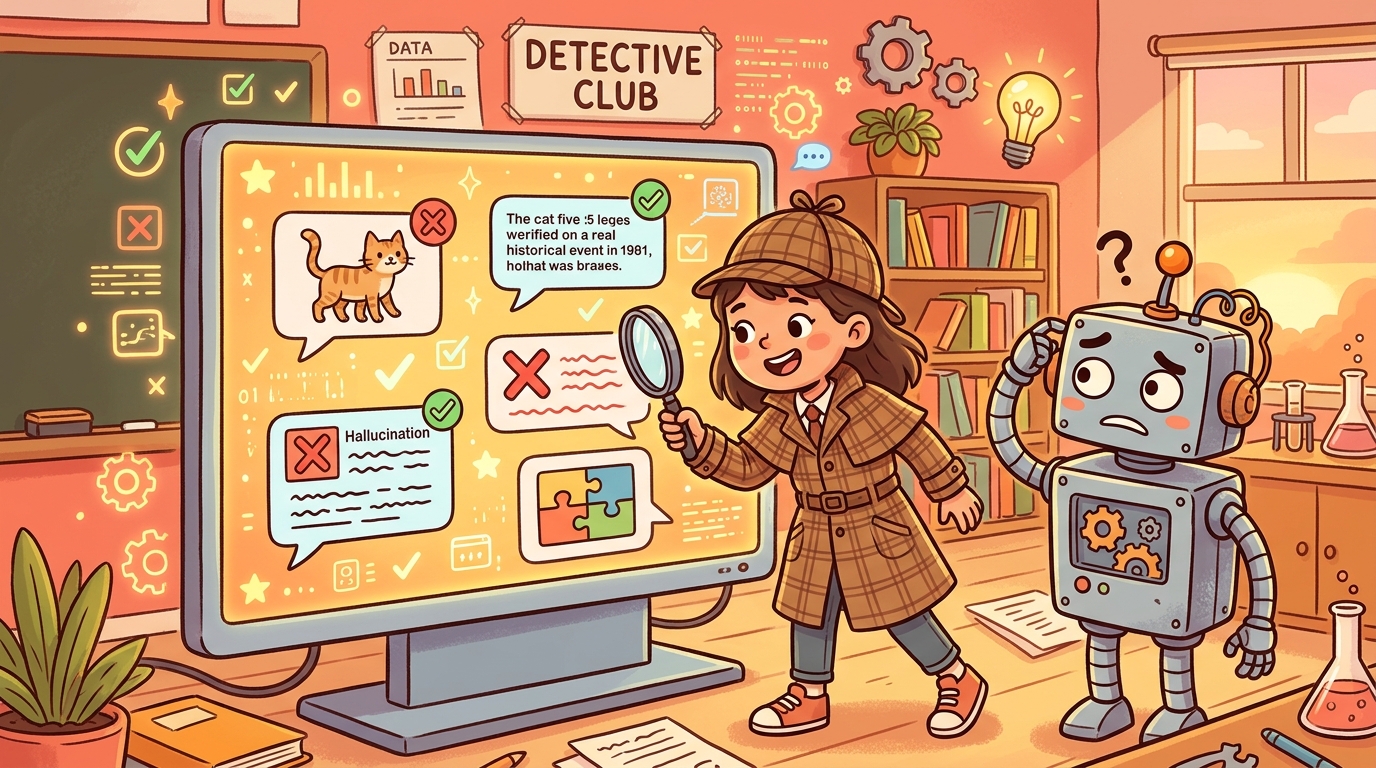
In this chapter, you are going to learn how to put on your detective hat, grab your magnifying glass, and figure out when an AI is telling the truth — and when it is accidentally making things up.
3.1 — Does AI Always Tell the Truth? 🤥
Section titled “3.1 — Does AI Always Tell the Truth? 🤥”Have you ever played a game with a friend who didn’t actually know the rules, but they pretended like they did? They might say, “Actually, if I roll a six, I get to steal all your points. That’s a totally real rule!” They say it with so much confidence that you almost believe them.
Sometimes, AI acts just like that friend!
AI systems are designed to be super helpful. They want to give you an answer so badly that if they don’t know the real facts, they might just stitch together a bunch of words that sound correct.
When an AI confidently makes something up that isn’t true, computer scientists call it a HallucinationHallucination: When an AI confidently gives you information that sounds true but is completely made up. The AI isn't lying on purpose — it just predicted words that sounded right without knowing if they were actually correct. (ha-loo-sin-A-shun).
An AI doesn’t hallucinate because it wants to lie to you or be mean. It hallucinates because it doesn’t actually understand the words it is typing. It just knows that certain words usually go together. If you ask an AI, “Who was the first dinosaur to walk on the moon?”, it might hallucinate a completely fake story about a T-Rex named Buzz in a spacesuit!
3.2 — Fact or Fiction 🕵️
Section titled “3.2 — Fact or Fiction 🕵️”Because we know that AI can hallucinate, we can never blindly trust what it says. Instead, we have to become AI Detectives.
The number one rule of being an AI Detective is:
Trust, but Verify.
Section titled “Trust, but Verify.”
This means it is okay to use AI to get ideas or learn something new, but you must always verifyverify: To check that something is true by looking it up in a trusted source — like a book, a safe educational website, or a trusted adult. (check) to make sure the information is actually true. You do this by cross-checking the AI’s answer with trusted sources!
If an AI tells you a “fact” for your science report, ask yourself:
- 📚 Can I find this same fact in a library book?
- 👩🏫 Does my teacher or a trusted adult know if this is true?
- 🌐 Can I find this information on a safe, educational website (like National Geographic Kids or NASA)?
If you can’t find the information anywhere else, there is a very good chance the AI hallucinated!
3.3 — The Human Advantage 🌟
Section titled “3.3 — The Human Advantage 🌟”Sometimes, people worry that AI is so smart it might replace human brains. But AI Detectives know a secret: Humans have a massive advantage over computers!
AI might be able to read a million books in one second, but it has never lived in the real world.
| What AI Can Do | What AI Has Never Done |
|---|---|
| Write a poem about an apple | Tasted one |
| Explain how to put on a band-aid | Felt how much a scraped knee hurts |
| Write a joke | Actually know what is funny |
| Describe a storm cloud | Smelled the air before a storm |
Humans have Common SenseCommon Sense: The ability to understand how the world works without needing to read a book about it. You just know a bowling ball is heavier than a feather! and EmpathyEmpathy: The ability to understand and share the feelings of another person — knowing your friend feels sad when they drop their ice cream, and wanting to help., and real-world experience.
Common sense helps us understand how the world works without needing to read a book about it. You just know that a bowling ball is heavier than a feather, and that you shouldn’t wear a heavy winter coat into a swimming pool. An AI might not know those things unless a human explicitly typed them into its code.
We also have empathy. If your best friend drops their ice cream cone on the sidewalk, you instantly feel bad for them. You might give them a hug or offer to share your snack. If you told an AI that your ice cream fell, it wouldn’t feel sad for you. It might just give you a science lesson on gravity!
And because of our real-world experience, we can look out the window, smell the air, and know if a storm is rolling in. If you hold up a painting of a storm cloud in front of a computer’s camera, the AI might think it is actually raining outside — because it sees the pattern of a dark cloud. But a human with common sense would immediately know it’s just a painting.
That is why humans must always be in charge of AI. We have the human advantage of knowing what is real, what makes sense, and what is fair.
Chapter 3 Activity: Two Truths and an AI Lie 🐙
Section titled “Chapter 3 Activity: Two Truths and an AI Lie 🐙”Your Mission: It is time to practice your detective skills! You are going to play a game called “Two Truths and an AI Lie.”
Step 1: Read the Clues
Section titled “Step 1: Read the Clues”Below are three “facts” about the octopus. Two of them are totally real facts. One of them is a hallucination that an AI made up!
- An octopus has three hearts.
- An octopus can change the color of its skin to hide from predators.
- An octopus uses its tentacles to build small underwater campfires to stay warm.
Step 2: Investigate!
Section titled “Step 2: Investigate!”Don’t just guess! Use your trusted sources to find the truth. Ask a librarian, look in an animal encyclopedia, or use a safe search engine to research the octopus.
Step 3: Catch the Hallucination
Section titled “Step 3: Catch the Hallucination”Which fact is the AI lie? Once you find it, explain to a partner why an AI might have made that mistake.
🎉 Great job, Detective! You are now an expert at evaluating AI content.